Your emergency fund needs a finish line
Most parents keep adding to their emergency fund and never know when it's enough. So they stop too early, or they keep piling cash and call it safe.
The finish line is your monthly essentials times 12.
Below that line, every dollar guards your family. Above it, every dollar can start growing for your family. Crossing it takes one number, and finding that number costs you about 10 minutes.
I found mine running a company through Egypt's 2011 revolution, with 35 people on my payroll. Here are the 5 things that change the day you cross it.
Change 1: a surprise bill stops sending you back to zero
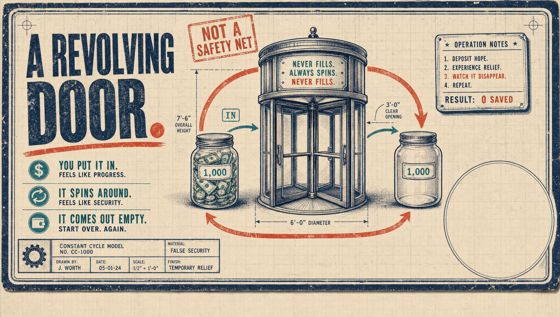
Many families hold a small cushion, maybe a thousand dollars. One real bill empties it: a car repair, a vet visit, a broken laptop. You refill it, and a few weeks later the next bill wipes it out again.
That's a revolving door, and it feels like bailing a boat with a cup.
The numbers back this up. In Bankrate's January 2026 survey of US adults, only 30% said they'd pay a $1,000 emergency from savings. 33% said they'd go into debt, mostly on credit cards.
On a card at 20-something percent, the hole gets deeper every month.
With 12 months of essentials behind you, one bill becomes a normal Tuesday.
The move: aim for 1 month of essentials first, then 2, and stack them like bricks.
Change 2: your next dollar changes jobs
This is the big one.
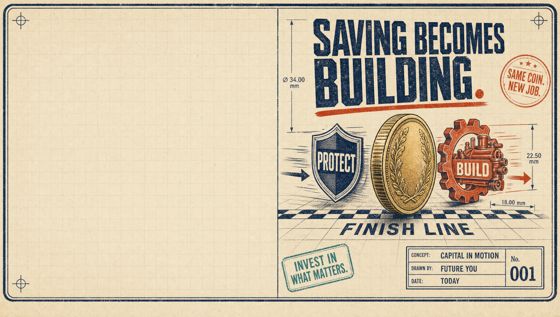
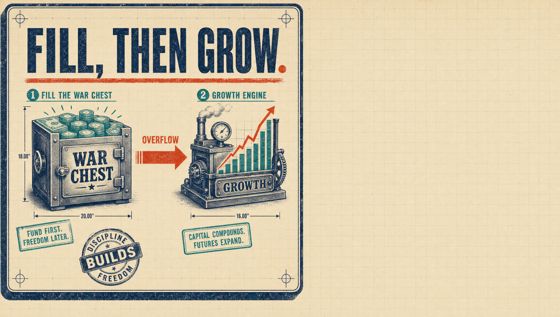
Below the finish line, every dollar has one job: protect the family. Above it, the same dollar gets a new job: build the family. That line is where your Safety Net hands over to your Growth Engine.
Most parents never feel this switch, because they never set the line. So the saving never ends and the building never starts.
The account can stay the same. The job changes.
Picture it on a real paycheck. Once your war chest is full, the next $200 a month stops sitting in savings and starts buying a broad index fund, the whole market. Left alone for 20 years at a 7% average yearly return, $200 a month grows to about $104,000. You'd have put in $48,000 of it yourself.
That's the same money, aimed at a very different future. Markets go up and down, and 7% is an assumption for the example, so treat it as an illustration.
The war chest
Here's where people push back. 12 months sounds like far too much. I thought so too, until the ground moved.
In 2011 I was running a company in Egypt when the revolution started. Tanks on the street, no police, business frozen overnight. 35 people were on my payroll, and at home we had a newborn daughter.
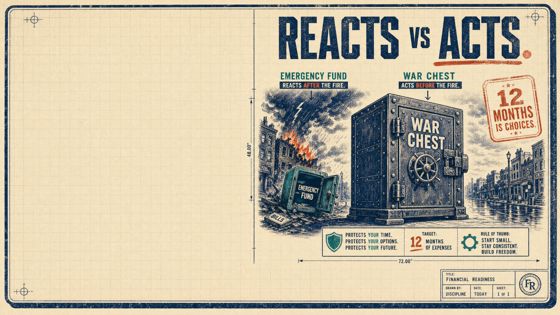
Around me, companies were letting people go to survive. I didn't have to, because I had a buffer built before the crisis. I called it the war chest.
For weeks nothing normal worked: the plans, the pipeline, the payroll. We cut costs and kept every person. Everyone shared a little pain, and every person kept their job. When it settled, we scaled back up stronger.
An emergency fund reacts after the fire starts. A war chest gives you options before it does. That's why 12 months is choices.
Change 3: you stop chasing the interest rate
Below the finish line, people hop from bank to bank for a slightly better rate.
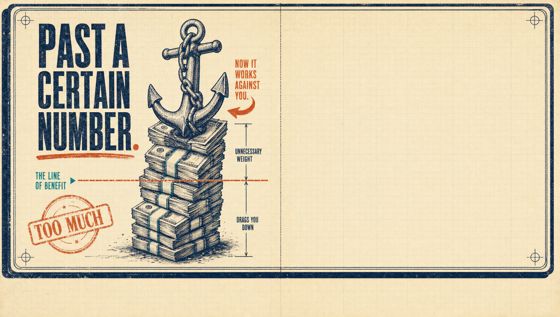
Above it, the rate matters much less, because a big pile of cash has a quiet leak called inflation. Cash above your Real Number earns some interest, and rising prices and tax take part of it back. The cash feels safe while it slowly shrinks, like a bucket with a hairline crack.
The real cost is a pile that never gets invested. So fill the war chest, then send everything above the line to the Growth Engine.
Change 4: the fear turns off
You know the feeling at the checkout. The total climbs and you do the quiet math in your head.
That feeling comes from having no floor under you, and your income has little to do with it. Money stress is mostly too many open decisions.
The war chest is the floor. With 12 months behind you, a rough month is a bump. A hard conversation with a boss gets easier when a year without income is survivable.
That calm is the real product here. The nights you sleep because of the number.
Change 5: your kids' clock starts
Once the family is safe and the engine is running, you can plan the long game for your kids.
My daughter, Nour, once looked at her savings and said, "Papa, what do I do with this? It's just sitting there."
That question only shows up after the fear is gone. So we started small: a little into 2 boring index funds, money with decades to grow. She practised first with pretend money on a free app, so a red day stopped scaring her. And she learned the rule many adults never do: don't panic, and don't sell.
Time does the work here. You can't start that clock while you're still bailing the boat. You start it the day you cross the finish line.
Your step tonight
Add up your essentials for one month: rent, food, power, transport, insurance, minimum debt payments. Multiply by 12. Write that number on the fridge. That's your finish line.
You were simply never given the number.
To see why 3 months falls short, read How big your emergency fund really needs to be. To climb toward the line one rung at a time, read How much emergency fund is enough, and when to stop.
Source: Bankrate, Emergency Savings Report, January 2026, survey of US adults. The $104,000 figure is an illustration: $200 a month for 240 months at 7% a year, compounded monthly. Education only, never financial advice.